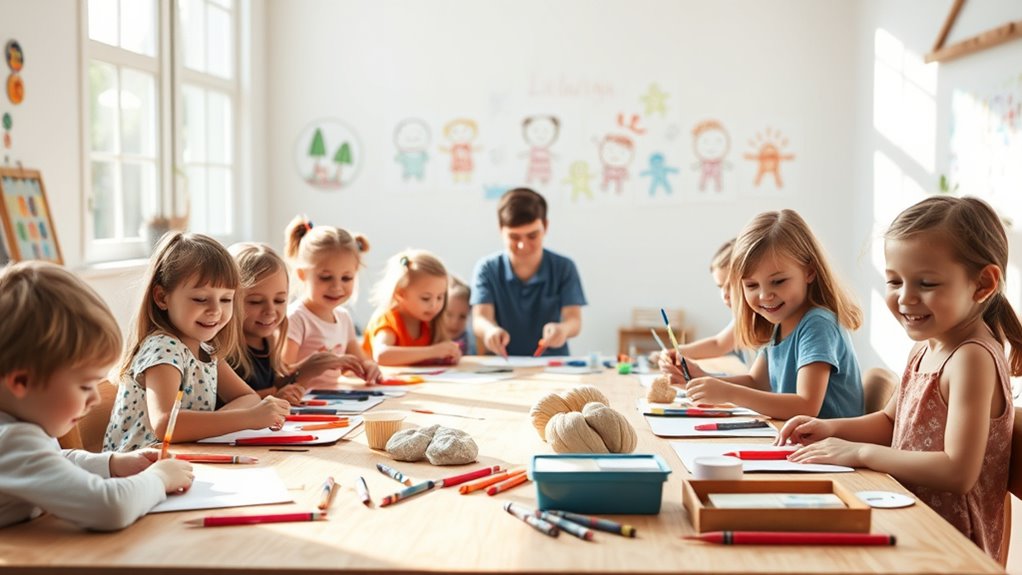

To help kids cope, involve them in creative activities like drawing, storytelling, or arts and crafts, which allow them to express their emotions in developmentally appropriate ways. Encourage social activities such as group games or collaborative projects, fostering a sense of connection and support. Mindfulness exercises and imaginative play also improve emotional regulation. By using these engaging, tailored activities, you’ll promote resilience and emotional well-being—keep exploring to discover more ways to support their growth.
Key Takeaways
- Incorporate age-appropriate arts and crafts to help children express emotions creatively.
- Use storytelling and role-playing activities to build problem-solving and emotional regulation skills.
- Engage children in mindfulness exercises like breathing games or guided imagery to reduce stress.
- Encourage drawing or writing to help kids articulate feelings and process stressful experiences.
- Foster social activities such as group games or collaborative projects to strengthen support networks and resilience.

How can we better support children as they navigate stress and develop resilience? The key lies in providing engaging, developmentally appropriate activities that help them build a broad set of coping skills. Evidence-based programs like PSL demonstrate that carefully designed participatory activities can markedly enhance children’s ability to manage stress. Over five years, researchers tested activities that children willingly participate in, leading to notable improvements in their coping strategies both immediately after the intervention and a year later. Using simple tools like the Kidcope and Draw and Write techniques, children can express their practical responses to stress, offering valuable insights into their emotional world. The positive feedback from children, teachers, and parents highlights that these activities not only improve coping abilities but are also highly appreciated because they’re engaging and accessible. Research evidence supports that teaching coping skills early can have lasting benefits for mental health. When designing activities, it’s essential to consider what is developmentally appropriate. Children respond best to activities that match their age and cognitive level, making participation enjoyable and meaningful. For preschoolers, understanding their unique coping patterns is critical. Kids aged 4–5 tend to use positive coping, negative emotional expression, or emotional inhibition, with anxious children more likely to resort to maladaptive strategies, especially in controllable stressful situations. Recognizing these patterns early enables caregivers to target interventions that foster healthier coping. Since preschoolers react differently to stress depending on whether the situation feels controllable or not, activities that teach them how to handle both types can promote resilience and reduce anxiety over time. Incorporating developmentally appropriate activities ensures that children are more receptive and engaged in learning effective coping strategies.
Engaging, age-appropriate activities enhance children’s stress management and resilience, benefiting their emotional well-being over time.
You should also regard that children and adolescents use a variety of coping strategies that evolve with age. Young children often rely on emotion-focused methods like socializing or distraction, which help them manage feelings of loneliness. As they grow, they begin to use problem-focused strategies alongside emotion-focused ones, showing a natural developmental shift. Social connection remains a core element across all ages. Activities that promote social interaction, like group games or collaborative projects, serve as effective emotional regulation tools. Tailoring activities to match children’s developmental stages ensures they learn both emotional regulation and problem-solving skills without feeling overwhelmed.
Children and adolescents themselves recognize the importance of diverse coping strategies. They often turn to family, friends, teachers, or even animals and health professionals for support. Providing opportunities for them to explore different ways of coping—such as creative arts, social activities, or mindfulness exercises—empowers them to build resilient responses to stress. When these activities are designed with their developmental needs in mind, they become more effective in helping children develop a resilient mindset. By fostering a supportive environment filled with creative, age-appropriate activities, you give children the tools they need to navigate stress confidently and grow stronger through life’s challenges.

Arts & Crafts Supplies Kits & Materials Set for Kids, Toddler – Carl & Kay
ALL INCLUSIVE CRAFT KIT: Looking for a fun one-stop, ready-for-anything craft supply bundle that covers all the basics?…
As an affiliate, we earn on qualifying purchases.
As an affiliate, we earn on qualifying purchases.
Frequently Asked Questions
How Can Parents Encourage Creativity During Stressful Times?
During stressful times, you can encourage creativity by providing a calm, dedicated space for your child to express themselves through art or play. Offer a variety of simple, accessible materials like clay or recycled items, and join in their activities to model a positive attitude. Listen attentively, celebrate their ideas, and emphasize the process over perfection. This helps them relax, build resilience, and develop problem-solving skills while feeling supported.
Are There Activities Suitable for Children With Special Needs?
Yes, there are activities suitable for children with special needs. You can try sensory activities like homemade dough, finger painting, or textured materials to develop fine motor skills and sensory exploration. Building with blocks or Lego enhances spatial awareness. Outdoor play such as sand or chalk supports sensory integration and gross motor skills. Adapted sports, swimming, and movement games also promote physical and social development, making activities engaging and accessible for every child’s unique abilities.
What Are Quick, Calming Activities for Anxious Kids?
When anxiety hits, you need quick fixes to calm your child down. Try belly breathing—have them lie down and place a hand on their stomach, taking deep breaths until they settle. Splash cold water on their face or offer a sip of ice water for instant relief. Gentle movement like swinging or a short dance can also do the trick, helping them feel grounded and in control in no time.
How Can Screen Time Be Integrated Into Creative Activities?
You can integrate screen time into creative activities by choosing educational apps that inspire hands-on projects, like creating digital art or music videos. Encourage your child to extend digital ideas into physical crafts or experiments, blending technology with real-world play. Use screens strategically to promote social interactions through shared games or video chats, fostering teamwork and emotional expression. Balancing screen use with traditional activities supports your child’s overall creativity and cognitive development.
What Role Do Outdoor Activities Play in Coping Strategies?
Did you know outdoor activities can reduce children’s stress levels by up to 50%? They play a crucial role in coping strategies by promoting relaxation, emotional regulation, and resilience. When you encourage kids to explore nature or play outside, you’re helping them manage anxiety and build confidence. These activities teach problem-solving and risk assessment, empowering children to handle challenges calmly and develop healthier ways to cope with stress and emotions.

JUSTQUNSEEN 6pcs Insect Finger Puppet Set, Mini Hand Puppets Suitable for Kids, Cute Insect Animal for Role-Playing and Storytelling, Realistic Finger Puppet for Toddlers
New finger puppet character:The finger puppet series has been updated, and the insect series has been added! Including…
As an affiliate, we earn on qualifying purchases.
As an affiliate, we earn on qualifying purchases.
Conclusion
Remember, just like a seed needs gentle care to grow into a strong tree, your support helps children blossom. Through creative activities, you’re providing them with a safe space to express their feelings and build resilience. Think of these moments as sunlight and water—nurturing their inner strength. With patience and love, you’re helping them develop into vibrant, confident individuals ready to face any storm that comes their way.

Breathe Like a Bear: 30 Mindful Moments for Kids to Feel Calm and Focused Anytime, Anywhere
As an affiliate, we earn on qualifying purchases.
As an affiliate, we earn on qualifying purchases.

Excellerations 8.5 x 11 inch Beginner's Preschool Picture Story Journals, Drawing and Writing Notebook – Pack of 10 for Kids and Children Educational
LAYOUT: Preschool journal has 2 lines and large space for drawing. The lines contain a red baseline, a…
As an affiliate, we earn on qualifying purchases.
As an affiliate, we earn on qualifying purchases.