To DIY your divorce, you’ll need to fill out essential forms like the Petition for Dissolution of Marriage (Form FL-100) to start your case, along with a Summons (Form FL-110) to notify your spouse. You must also prepare Proof of Service, financial disclosure forms, and any additional custody or property documentation if applicable. Ensuring all paperwork is correct is crucial, and if you keep going, you’ll learn more about each step and what’s required.
Key Takeaways
- File the Petition for Dissolution of Marriage (Form FL-100) to start the case.
- Serve your spouse with the Summons (Form FL-110) and Proof of Service (Form FL-115).
- Complete financial disclosure forms such as Declaration of Disclosure (Form FL-140) and Income and Expense Declaration (Form FL-150).
- Prepare child custody and support forms if applicable, like FL-105 and FL-311.
- Finalize with the Judgment (Form FL-180), then file the Notice of Entry of Judgment (Form FL-190).
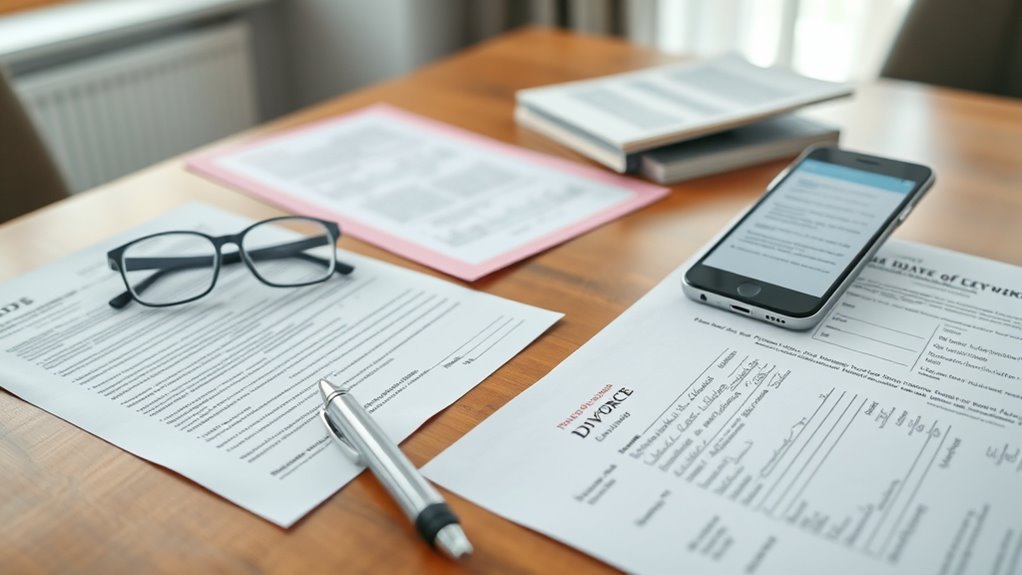
Thinking about ending your marriage without hiring an attorney? Handling your own divorce can seem daunting, but understanding the necessary forms makes it more manageable. The process begins with the Petition for Dissolution of Marriage (Form FL-100). This essential document kicks off your case by providing details about your marriage, listing assets, debts, and specifying your requests for child custody, support, and property division. Alongside this, you’ll need to serve your spouse with a Summons (Form FL-110), which informs them of the divorce and explains how they can respond. Once your spouse receives the papers, you must file a Proof of Service of Summons (Form FL-115) to prove they’ve been officially notified. If your spouse agrees to the process, they might sign a Notice and Acknowledgment of Receipt (Form FL-117), which confirms they received the papers without contesting.
All initial court forms should be filed either in person or electronically through e-filing, depending on your local court’s procedures. If you have children, additional forms come into play. You’ll need to complete the Declaration Under UCCJEA (Form FL-105), which provides details about your children’s residency and jurisdiction. You can also submit the Child Custody and Visitation Application Attachment (Form FL-311) to outline or request custody and visitation arrangements. To determine child support obligations, you may want to use a Child Support Worksheet, which helps calculate financial responsibilities. Protecting sensitive information is vital, so filing a Confidential Information Sheet – WITH CHILDREN is recommended. Depending on your case, other forms for parenting plans, travel restrictions, or special custody orders might be necessary.
Financial disclosures are equally important. The Declaration of Disclosure (Form FL-140) acts as a cover sheet for your financial documents. You’ll also need to fill out an Income and Expense Declaration (Form FL-150) to detail your monthly income and expenses, attaching relevant pay stubs or financial statements. The Schedule of Assets and Debts (Form FL-142) lists all property, debts, and obligations, ensuring transparency. For more detailed property listings, you can use the Property Declaration (Form FL-160). Once completed, a Declaration Regarding Service of Declaration of Disclosure (Form FL-141) confirms that you’ve exchanged and filed these disclosures with your spouse and the court. It is important to remember that these disclosures are essential for a fair division of assets and debts. Additionally, understanding the importance of accurate documentation can help prevent delays or issues in finalizing your divorce.
Service of these forms must be carried out by a third party, not the filing spouse. After serving your spouse, you need to file the Proof of Service with the court. If your spouse doesn’t respond within 30 days, you can request a default judgment by submitting the appropriate forms. If they respond, additional responsive forms or counter-petitions may be necessary. When the case is ready to close, the judge signs the Judgment (Form FL-180), which finalizes the divorce, including custody, support, and property division. Before the final judgment, a Judgment Checklist (Form FL-182) helps verify that all paperwork is complete. Once signed, a Notice of Entry of Judgment (Form FL-190) is filed, officially closing your case. Navigating these forms can be straightforward with careful attention, but always double-check your local court’s specific requirements to make sure everything is in order.
Top picks for "divorce paper form"
Open Amazon search results for this keyword.
As an affiliate, we earn on qualifying purchases.
Frequently Asked Questions
Can I File for Divorce Without a Lawyer?
Yes, you can file for divorce without a lawyer in most states. You’ll need to complete essential forms like a complaint or petition, a summons, and some administrative paperwork. Courts often provide free DIY packets or online resources to guide you. Just make sure you meet residency requirements, understand the procedures, and consider consulting a legal aid organization if you need extra help to avoid mistakes.
How Do I Change My Name Through Divorce Papers?
You can change your name through divorce papers by requesting it during your divorce filing or including a name change clause in the divorce decree. If the decree doesn’t specify it, you’ll need to file a separate petition for a legal name change. Use the divorce decree as proof to update your ID and records. Certified copies and proper documentation are essential for completing the process smoothly.
What if My Spouse Refuses to Sign the Forms?
If your spouse refuses to sign the forms, don’t fret—it’s a common hurdle, not a dead end. You can file for a default divorce after proper service and waiting out the response period. The court can grant your divorce without their signature, and you’ll attend a hearing where a judge may finalize it. Hiring a lawyer can help navigate contested issues and guarantee your rights are protected during this process.
Are DIY Divorce Papers Valid in All States?
DIY divorce papers aren’t valid in all states. You need to check your state’s specific rules and required forms, as each state has its own procedures and paperwork. Some states accept self-prepared divorce documents if they follow local court rules, but others might require court approval or additional documentation. To guarantee your divorce is legal, research your state’s requirements or consult local court resources before filing.
How Long Does the Divorce Process Take With DIY Forms?
The DIY divorce process typically takes around 3 to 4 months if both parties agree on issues like property and custody. You start by filing your paperwork, then wait 60 days after serving your spouse, which is the mandatory cooling-off period. Responding to any disputes or delays can extend the process. Staying organized and meeting deadlines speeds things up, but uncontested divorces tend to be quicker.
Conclusion
Now that you know which forms to prepare, your next step could change everything. Will you confidently submit your paperwork and start this new chapter, or will unforeseen obstacles catch you off guard? The path ahead is filled with choices, and each one matters. Stay alert, stay prepared, and remember—your journey to divorce is just beginning. Are you ready to take that essential next step? The outcome depends on what you do now.