

To prepare for mediation, gather all key documents like financial records, property deeds, and relevant legal agreements. Clarify your priorities, including custody, asset division, and support, and be ready to negotiate with an open mind. Choose an experienced mediator and organize your thoughts and materials beforehand. Practice potential discussions so you’re confident during sessions. Staying respectful and focused helps the process go smoothly. Keep in mind, more tips can guide you through each step of successful mediation.
Key Takeaways
- Gather and organize all essential documents, including financial records, property deeds, and relevant agreements.
- Clarify your priorities and desired outcomes while remaining open to negotiation and compromise.
- Develop a collaborative mindset by practicing active listening, respectful communication, and managing emotions.
- Choose a qualified mediator, prepare a comprehensive mediation binder, and confirm all parties’ availability.
- Prepare potential settlement options, justify proposals with external standards, and outline your preferred outcomes.
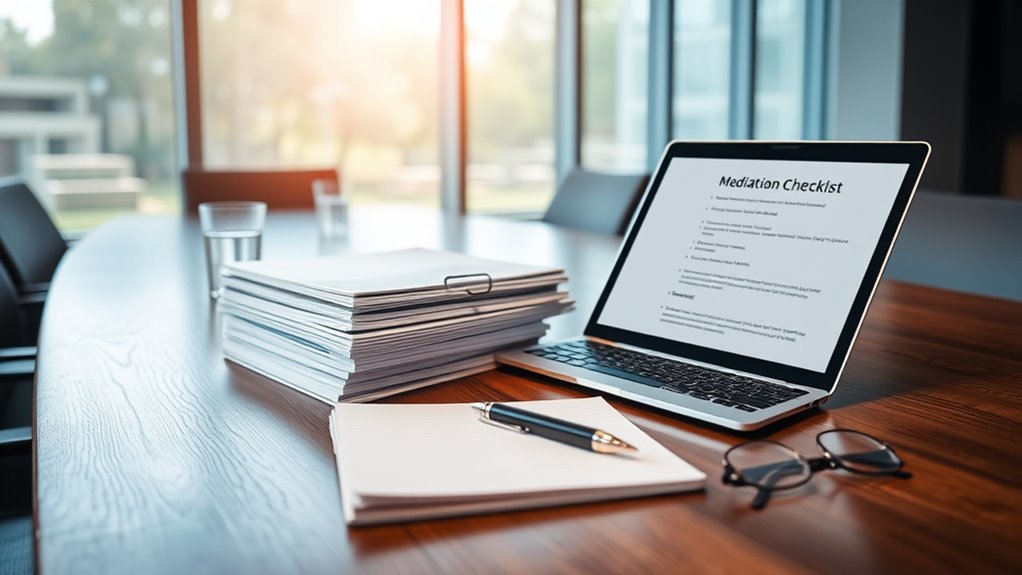
Preparing for mediation involves organizing key documents, understanding your priorities, and developing a clear strategy. This initial step is essential because it sets the foundation for a productive session. Start by gathering all essential financial documents, including bank statements, tax returns, and any relevant financial records. These will help you clearly present your financial situation and support your claims. Collect property deeds for all properties involved, making sure you have accurate documentation of ownership. If there are any marital agreements, such as pre-nuptial or post-nuptial agreements, review them thoroughly, as they can greatly influence the outcome. Create detailed lists of your assets and liabilities, which will facilitate fair discussions about property division and financial responsibilities. Also, gather any supporting contracts like leases or mortgages related to shared assets, so you have a complete picture of your financial commitments. Understanding your financial documentation is crucial for transparency and credibility in mediation.
Understanding your priorities is the next essential step. Reflect on the key issues you want to address, such as child custody, asset division, and spousal support. Decide what your ideal arrangements are but remain open to negotiation. For child custody, determine what kind of visitation schedule or custody arrangement you prefer, keeping the child’s best interests in mind. When it comes to dividing assets, think about what is fair and what you’re willing to compromise on. Consider your spousal support needs and set realistic expectations. Identifying areas where you’re flexible will help facilitate smoother negotiations. Recognizing your priorities upfront allows you to approach mediation with clarity and purpose, making it easier to stay focused during discussions.
Adopting a collaborative mindset enhances your chances of reaching an agreement. Focus on finding common ground and understanding the other party’s perspective. Practice active listening and use “I” statements to express your thoughts without sounding confrontational. Maintaining respectful dialogue is essential for creating a positive environment, even when disagreements arise. Manage your emotions through self-care and mindfulness techniques, so you stay composed and clear-headed during mediation. Establish clear expectations for the process, including the mediator’s role and your desired outcomes, to avoid misunderstandings.
Preparation also involves logistical planning. Choose a mediator with relevant experience and good referrals, and prepare a well-organized mediation binder containing all your key documents. Make sure that everyone involved is available and committed to attending the session. If needed, assemble a support team of legal or financial advisors to provide expert guidance. Develop a negotiation strategy based on your strengths and weaknesses, and consider practicing difficult conversations through role-playing exercises. Think about potential settlement options and assess their feasibility, applying external standards to justify your proposals. Lastly, prepare any necessary legal or financial approvals beforehand, and have a detailed settlement booklet ready to outline your preferred outcomes. By taking these steps, you’ll enter mediation well-prepared, confident, and equipped to reach a fair resolution.

Thoughtful End-of-Life Planner Binder – Complete & Easy-to-Use Organizer for Peaceful Preparation, Final Wishes, Estate & Death Planning – All Your Essential Emergency Documents in One Place
Peace of Mind for You & Your Loved Ones: ZICOTO’s end of life planner organizes final wishes, key…
As an affiliate, we earn on qualifying purchases.
As an affiliate, we earn on qualifying purchases.
Frequently Asked Questions
How Early Should I Arrive at the Mediation Session?
You should aim to arrive about 30 minutes early for your mediation session. This gives you enough time to handle parking, check in, and find the room or platform without rushing. Arriving early also helps you settle, review your notes, and address any last-minute concerns. Plus, it shows respect for the process and mediator’s schedule, setting a positive tone for a productive session.
Should I Bring Legal Documents or Evidence?
You should definitely bring legal documents and evidence, like in a hypothetical case where a slip-and-fall victim presents photos of the hazardous condition and medical records to substantiate injuries. Bringing these helps establish your claims clearly and supports your position. Organize your evidence with clear labels and summaries, and consider confidentiality—only share sensitive info with the mediator if necessary. Well-prepared documents can influence settlement talks positively.
What Should I Wear to the Mediation?
You should wear professional, neutral attire that shows respect and neutrality. Opt for a suit or business casual clothes, depending on the setting, with conservative styles and colors like navy or gray. Prioritize comfort for longer sessions and make sure your clothes are clean and well-fitting. Avoid flashy patterns or logos, and dress code appropriately for virtual or in-person mediations. Your appearance should convey seriousness, credibility, and cultural sensitivity.
Can I Bring a Support Person or Lawyer?
Yes, you can bring a support person or lawyer to mediation, but check with the mediator and all parties first. Support persons provide emotional backing but usually can’t speak during sessions unless permitted. Lawyers can actively participate, offer legal advice, and represent you. Always clarify roles beforehand and make sure everyone agrees. Be aware of confidentiality rules, and consider how your support person’s presence might influence the process.
How Should I Handle Emotional Stress Before Mediation?
You should acknowledge your feelings and practice calming techniques like deep breathing or mindfulness to handle emotional stress before mediation. Visualize successful engagement, organize your documents to boost confidence, and set clear goals. Use self-distancing language to gain perspective, and consider therapeutic support if needed. Taking these steps helps you stay focused, manage anxiety, and participate constructively, increasing your chances of reaching a positive resolution.
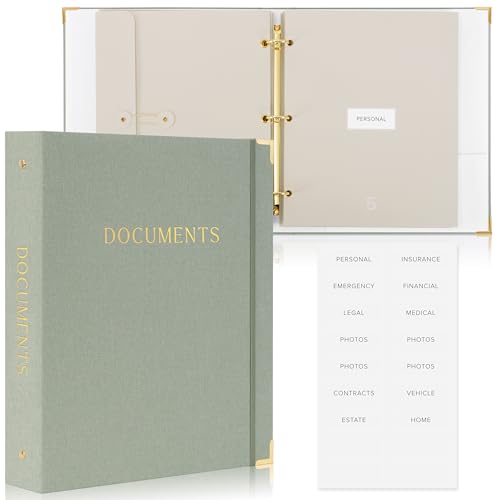
Sturdy Document Organizer Set with Folders – Beautiful Linen 3-Ring Binder Safely Stores All Important Documents & Files in One Place – Easy to Use Expanding Storage Incl. Envelopes, Pockets & Labels
Store (Family) Papers Safe & Sound: Keep all your essential papers safely in one spot with ZICOTOs’ important…
As an affiliate, we earn on qualifying purchases.
As an affiliate, we earn on qualifying purchases.
Conclusion
As you step into mediation, remember, you’re the captain steering your ship through calm and stormy seas alike. Stay focused, keep your eyes on the horizon, and speak with clarity and confidence. Trust your preparation, and let your calm voice be the steady anchor amidst swirling doubts. With each step, you’re weaving a path toward understanding and resolution. Embrace the journey ahead, knowing you’re equipped to turn turbulence into tranquil waters.

Mediation: Negotiation by Other Moves
As an affiliate, we earn on qualifying purchases.
As an affiliate, we earn on qualifying purchases.
professional mediator directory
As an affiliate, we earn on qualifying purchases.
As an affiliate, we earn on qualifying purchases.