
TL;DR

Get gifts for the two of you delivered free — and shop member deals
- Fast, free delivery on millions of items
- Access to Prime Big Deal Days deals on October 6–7
- Prime Video, Amazon Music and more included
Prebuilt AI workstations now often cost the same or less than building your own, thanks to component shortages and bulk buying. The choice depends on your need for control, speed, and support, not just price.
Imagine turning on your AI workstation and getting straight to work, without the hours spent hunting down parts, troubleshooting BIOS, or stressing over compatibility. That’s what the decision between building your own or buying prebuilt comes down to today. For years, building was cheaper, but in 2026, the game has shifted. Now, the real question isn’t just cost but what matters most to you: time, control, or peace of mind.
This guide breaks down the real tradeoffs—covering costs, performance, support, and the latest market trends—so you can choose what fits your workload and budget best. Whether you’re a hobbyist, researcher, or enterprise user, understanding these factors will help you avoid the trap of outdated assumptions and make smarter choices.
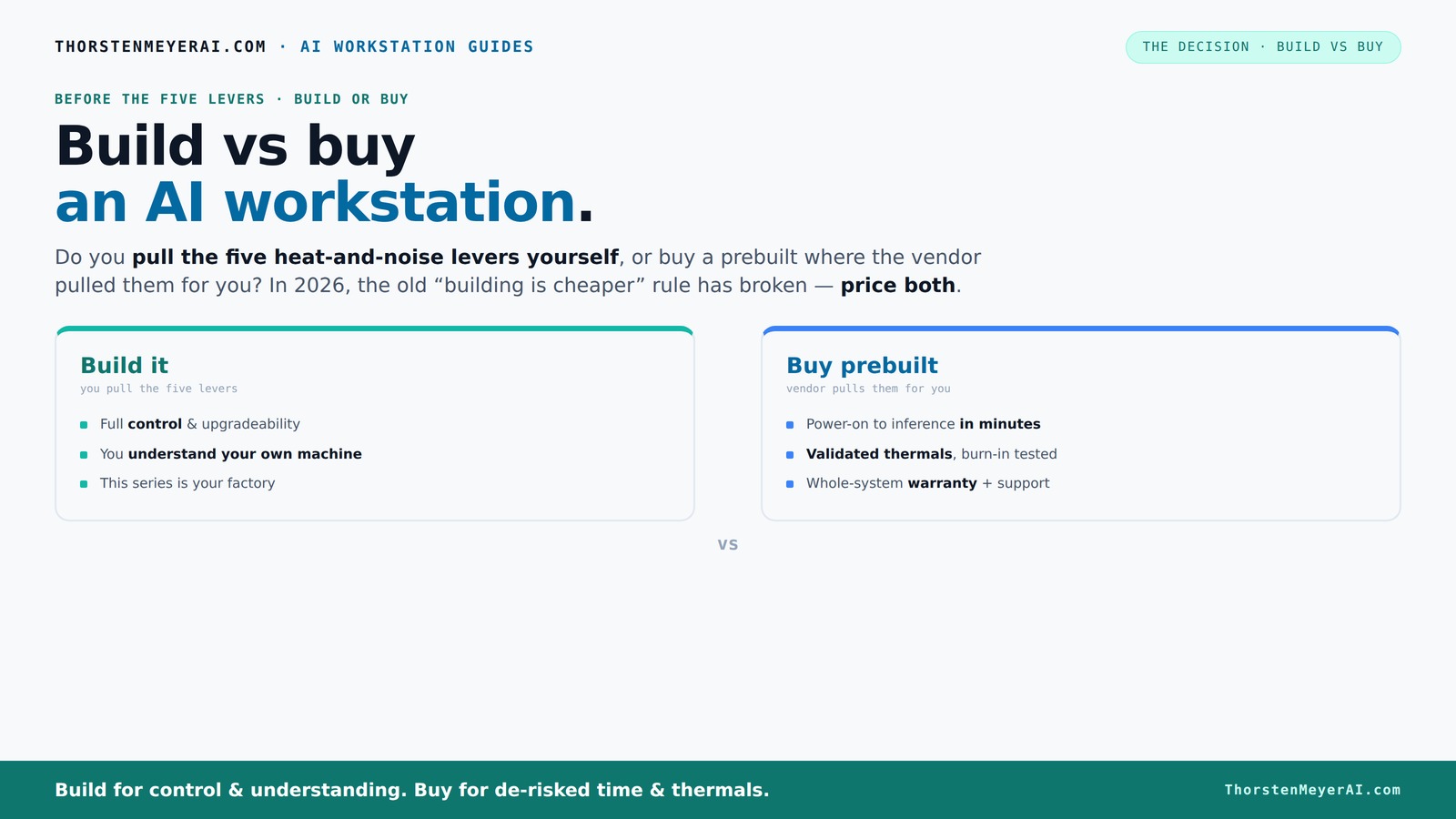
Build vs buy
an AI workstation.
The real question behind this whole series: do you pull the five heat-and-noise levers yourself, or buy a prebuilt where the vendor pulled them for you? And in 2026, the old “building is cheaper” rule has broken. Match your situation in Part 3.
Key Takeaways
- In 2026, prebuilt AI workstations often cost the same or less than DIY builds due to component shortages and bulk buying. Always price both options for your exact specs.
- Support, warranty, and validated thermals make prebuilts appealing for mission-critical workloads, reducing downtime and troubleshooting time.
- Building offers maximum customization and upgradeability but requires time, technical skill, and patience—ideal for hobbyists and highly specific needs.
- Latest market trends favor turnkey solutions with AI-optimized hardware, making prebuilt systems more reliable and faster to deploy than ever.
- Your choice depends on workload complexity, budget, timeline, and comfort with technical troubleshooting—not just the sticker price.
As an affiliate, we earn on qualifying purchases.
What Building vs Buying Actually Means for Your AI Workstation
Building your own AI rig means sourcing every part—GPU, CPU, RAM, cooling—and assembling it yourself. Buying prebuilt means choosing a ready-to-go system from a vendor like Lambda or Puget, who handle assembly, testing, and support. It’s like the difference between cooking from scratch versus ordering a gourmet meal that arrives perfect and ready to serve.
For example, a DIY build might let you pick a NVIDIA RTX 4090 with 24GB VRAM, paired with a quiet Noctua cooler and custom airflow. A prebuilt would have those components already validated, with thermal tuning done, and a warranty attached. The big difference? Time and hassle.
Deeply, this choice impacts not just initial setup but long-term reliability and performance. For more insights, see cheatng.com about navigating technical challenges. DIY gives you control over each component, enabling tailored cooling solutions or overclocking for maximum performance. But it also introduces risk: incompatible parts, assembly errors, or thermal issues that can hinder performance or cause hardware failure. Prebuilts mitigate these risks through factory validation, ensuring stability under sustained workloads—crucial when training large models or running continuous inference. The tradeoff is that prebuilt systems might not be as customizable, but they often save you from costly mistakes and downtime.
Who Should Opt for a Prebuilt System in 2026?
If your goal is to deploy quickly, avoid troubleshooting, or minimize downtime, a prebuilt system makes sense. Say you’re a data scientist needing to start training models tomorrow — prebuilt gets you there faster. Vendors now test their systems under sustained loads, often 24–48 hours, ensuring thermal stability and avoiding throttling.
High-end workloads with multiple GPUs? Vendors like Lambda or BIZON validate cooling and power delivery, so your system won’t crash mid-training. Plus, a warranty and support are priceless if your work is mission-critical. For example, a Lambda multi-GPU workstation with water cooling is often cheaper and more reliable than assembling your own, thanks to bulk buying and factory validation.
Choosing prebuilt systems in these scenarios isn’t just about convenience; it’s about reducing the risk of hardware failures or performance bottlenecks that can cost days or weeks of productivity. When time is critical, the added assurance of factory testing and support outweighs the potential savings of DIY.
When Building Your Own is Still the Cheaper Choice
Building a custom system can save money—if you’re willing to put in the time and effort. For instance, sourcing a quiet GPU and undervolting it yourself can shave hundreds off the cost of a prebuilt. But that savings isn’t guaranteed anymore, thanks to shortages and rising prices. Components like DDR5 RAM and high-end GPUs now cost 20–30% more than a year ago.
Deeply, DIY offers unmatched control over every aspect—cooling, airflow, component selection—allowing for tailored solutions that optimize performance and noise levels. Consider building vs buying a prebuilt AI workstation for your needs. For example, if you’re training a niche model requiring two GPUs and custom cooling, building might be your only option. Additionally, DIY can be more cost-effective when you already possess tools or spare parts, or if you want to upgrade incrementally over time. However, this approach demands technical skill and patience, and the potential for mistakes increases the longer the build process extends, which could offset initial savings.
The Real Cost Puzzle: Is Building Cheaper Today?
| Factor | Build | Buy |
|---|---|---|
| Component Prices | Higher due to shortages, especially GPUs & RAM | Bulk discounts, potentially lower overall |
| Assembly & Testing | Time-consuming, often $200–$400 in value | Included in price |
| Support & Warranty | None unless paid extra | Extended, system-wide support |
| Time to Deployment | 1–2 weeks or more | Ready in days |
In 2026, prebuilts often cost as much as or less than DIY, especially with the rising price of parts. Learn more about the latest trends at afterquotes.com. Vendors buy in bulk before shortages spike prices, passing savings to you and reducing the hassle of assembly and troubleshooting [2][3][7]. This shift means that the traditional cost advantage of building your own is narrowing or reversing. For detailed guidance, see cheatng.com. The implications? For many, the convenience, reliability, and support of prebuilts justify their slightly higher or comparable price, especially when factoring in the hidden costs of time and potential errors in DIY builds.
Performance, Upgrades, and Flexibility – Which Wins?
Building your own gives you the edge in fine-tuning hardware. Want a tuned GPU or a custom cooling loop? Build it yourself. You can swap out components over time, upgrade GPU memory, or add more storage. This flexibility allows you to adapt your system precisely to evolving workload demands, which is especially valuable for research or long-term projects where hardware needs change.
Prebuilts offer excellent performance, validated for prolonged workloads. But they’re often locked into specific configurations. Upgrading a prebuilt can be tricky—sometimes you’re limited to what the vendor allows. For more on customization options, visit rebelburst.com. For example, a high-end prebuilt with a 2nd GPU slot might be non-upgradable if the vendor’s design doesn’t include it. This means that while prebuilts are convenient, they may not fully support future expansion or customization, potentially necessitating a new purchase down the line.
Deeply, the choice impacts your ability to respond to new demands quickly and cost-effectively. Building gives you the power to upgrade only what you need, when you need it, often at a lower long-term cost, but at the expense of initial complexity.
Support, Warranties, and Downtime: Why It Matters
Prebuilt systems come with support from the vendor, often up to 5 years, with on-site repairs or fast replacements. For instance, Puget Systems offers dedicated support and extensive warranties, reducing the risk of prolonged downtime. This support ensures that any hardware issues are addressed swiftly, minimizing project delays and financial losses, especially critical in enterprise or research settings where downtime costs can be substantial.
DIY builds mean you’re on your own. Troubleshooting an obscure BIOS error or a failing power supply can take hours or days. If your AI training runs on a tight schedule, that downtime can cost thousands. Support contracts and warranties aren’t cheap, but they can save your project from grinding to a halt. The key is understanding that investing in support is often a cost-effective way to safeguard your productivity and avoid costly delays caused by hardware failures or compatibility issues.
Latest Trends in AI Workstations: What's Changing in 2026?
The market now favors turnkey solutions. Vendors integrate AI-optimized hardware, like NPU-assisted workloads, and preinstall software stacks (CUDA, PyTorch). This reduces setup friction and accelerates time-to-value. This trend indicates a shift toward more integrated, plug-and-play solutions that reduce the technical barrier for deploying AI workloads, especially for teams lacking extensive hardware expertise.
More vendors sell ready-to-run AI systems, designed for seamless deployment. AI-specific features, such as lower latency, power efficiency, and hardware validation, are now standard. This shift makes prebuilt systems increasingly attractive, especially for teams that prioritize speed and reliability over fine-grained customization. It also means that the cost of experimentation and iteration drops, enabling faster innovation cycles and reducing the risk of hardware incompatibility or setup errors.
What Should You Do? Your Decision Checklist
- Assess your workload: Is it multi-GPU, specialized, or standard? Consider the complexity and flexibility needed. For example, multi-GPU setups benefit from vendor validation to prevent bottlenecks and ensure stability.
- Calculate total costs: Include parts, assembly, support, and downtime risk. Remember, initial price isn’t everything; support and potential downtime costs can significantly impact overall value.
- Determine your timeline: Need it fast or flexible? Rapid deployment favors prebuilts, while custom builds may take longer but offer tailored performance.
- Consider your technical skill: Are you comfortable troubleshooting or customizing? High skill levels can make DIY more appealing, but beware of hidden costs like time and potential errors.
- Check warranty and support needs: Can you afford downtime? For mission-critical workloads, investing in support can save you from costly delays.
Matching these points to your situation will guide your choice. Want a quick, reliable system? Prebuilt wins. Want maximum control and upgrade paths? Building might be better.
Frequently Asked Questions
Is a prebuilt AI workstation worth the extra cost in 2026?
Yes, if you value quick deployment, reliable thermals, and support. The latest prebuilts often come with tested configurations and warranties that reduce downtime and troubleshooting, making them worth the premium for many users.Can I upgrade a prebuilt system later if my needs change?
It depends. Some prebuilts are designed for easy upgrades—adding RAM or storage—but major changes like replacing GPUs can be restricted by the vendor’s design. Check the upgrade paths before buying, especially for high-end workloads.How do I compare the total cost of building vs buying?
Factor in component prices, assembly, support, warranty, and potential downtime. While building might seem cheaper upfront, bulk discounts and vendor validation often make prebuilts competitive or even cheaper overall, especially with current shortages.Which is better for multi-GPU training: build or buy?
Vendors like Lambda validate multi-GPU setups with robust cooling and power, reducing the risk of throttling or failure. Building your own is possible but requires careful planning and expertise. For most, a prebuilt with multi-GPU support offers better reliability.What specs matter most for AI workloads: VRAM, CPU, or cooling?
GPU VRAM is crucial for large models and datasets. CPU and RAM matter too, for data preprocessing and multitasking. Cooling becomes vital under sustained loads to prevent throttling. Prioritize a balanced build tailored to your workload, whether DIY or prebuilt.Conclusion
In 2026, the choice between build and buy isn’t just about saving a few dollars. It’s about how quickly and reliably you want your AI system up and running. Prebuilts now often match or beat DIY costs, especially when factoring in support and validation.
So, next time you’re thinking about your AI workstation, ask yourself: do you want to run your workload or wrestle with hardware? The answer shapes your best move. Remember, in this game, speed and support often trump raw savings.
Halloween Picks
halloween
As an affiliate, we earn on qualifying purchases.